Contents
The main risk of a legacy system is not its age. It is the inability to change it with confidence. Successful modernization therefore does not start by rewriting code; it starts by making the system observable, decoupling dependencies and moving flows gradually.
The thesis
Modernize around the system before modernizing the system: measure, encapsulate, extract one journey, then retire only what is no longer used.
InfographicDecision framework · shareable block
01
See
Measure flows, dependencies and business outcomes.
02
Isolate
Create a stable, testable boundary.
03
Move
Migrate one full journey in stages.
04
Retire
Actually remove debt that is no longer needed.
Map the real risk
Inventory business capabilities, interfaces, batch jobs, data, users, critical periods and hidden dependencies. Add incidents, change lead time, scarce skills and manual controls.
This map prioritizes by value and risk. An old but stable isolated component may wait; a fragile interface blocking every release deserves early action.
Create a stable boundary
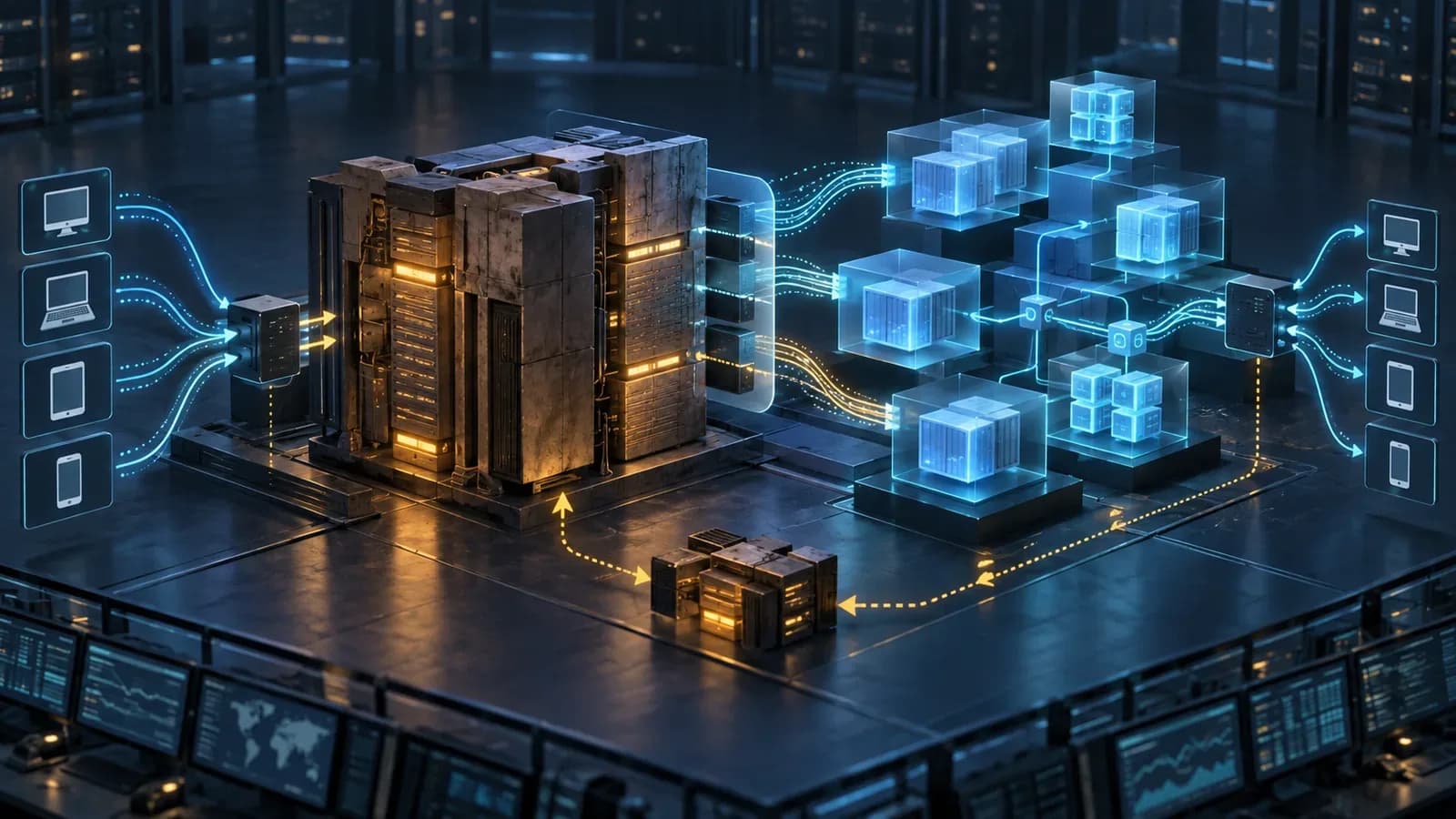
An API, facade or event layer can encapsulate the existing system. The boundary reduces consumers that depend on internal structures and creates a testable contract for new components.
The boundary is not an end state. It needs clear responsibility, metrics and a retirement plan or it becomes another permanent layer of complexity.
Extract one end-to-end journey
The strangler pattern progressively replaces a capability while the old system serves the remainder. Choose a journey valuable enough to prove the method but isolated enough to limit impact.
Move the interface, logic and data required for that journey. Route a small share of traffic, compare outcomes and expand only while indicators remain stable.
Govern data during coexistence
The hardest period is when two systems share responsibility. Define the master source for each record, synchronization rules, acceptable delay and conflict handling.
Avoid prolonged bidirectional writes. They multiply states that are difficult to explain. Prefer a transition with explicit ownership and a reconciliation log.
Prepare for controlled failure
Every cutover needs a stop threshold, rollback procedure, accountable owner and proof that rollback works. Combine technical and business observability: latency and errors, but also orders, cases, payments or cycle times.
Modernization ends with retirement. Remove obsolete routes, access, jobs and infrastructure; archive data as required; update documentation and controls.
TableModernization sequence · shareable block
| Deliverable | Exit condition | |
|---|---|---|
| 1. Observe | Flow and service map | Risks and owners known |
| 2. Encapsulate | API or event contract | Tests and telemetry active |
| 3. Extract | One complete journey | Comparable outcomes |
| 4. Cut over | Traffic and data transferred | Stable thresholds and tested rollback |
| 5. Retire | Old component removed | No remaining consumers |
What this framework does not replace
This framework structures a decision, but does not replace a technical inventory, contract review, performance testing, security assessment or estimate based on your actual environment.
Frequently asked questions
Should a legacy system be fully rewritten?+
Rarely. A full rewrite concentrates risk and delays value. Progressive extraction is often safer.
What is the strangler pattern?+
A method that gradually replaces capabilities behind a common boundary until the old system can be retired.
How do we prevent downtime?+
Use controlled coexistence, gradual routing, observability, contract tests and a verified rollback plan.
What should be modernized first?+
A journey with visible value, manageable dependencies and reliable metrics—not necessarily the most technically attractive component.
Turn the decision into an executable plan
DAILLAC can frame the options, document assumptions and deliver a measurable roadmap before a major commitment.
D
Written by
DaillacDigital strategy and software engineering — Saint-Jérôme · Greater Montreal
DAILLAC helps organizations make architecture, development, modernization and automation decisions.