AI · Models and evaluationOctober 2, 20265 min · updated October 15, 2026
GPT‑6.1 Sol: plan a migration without regressions in business workflows
Daillac research
OpenAI — Introducing GPT‑6.1 SolD
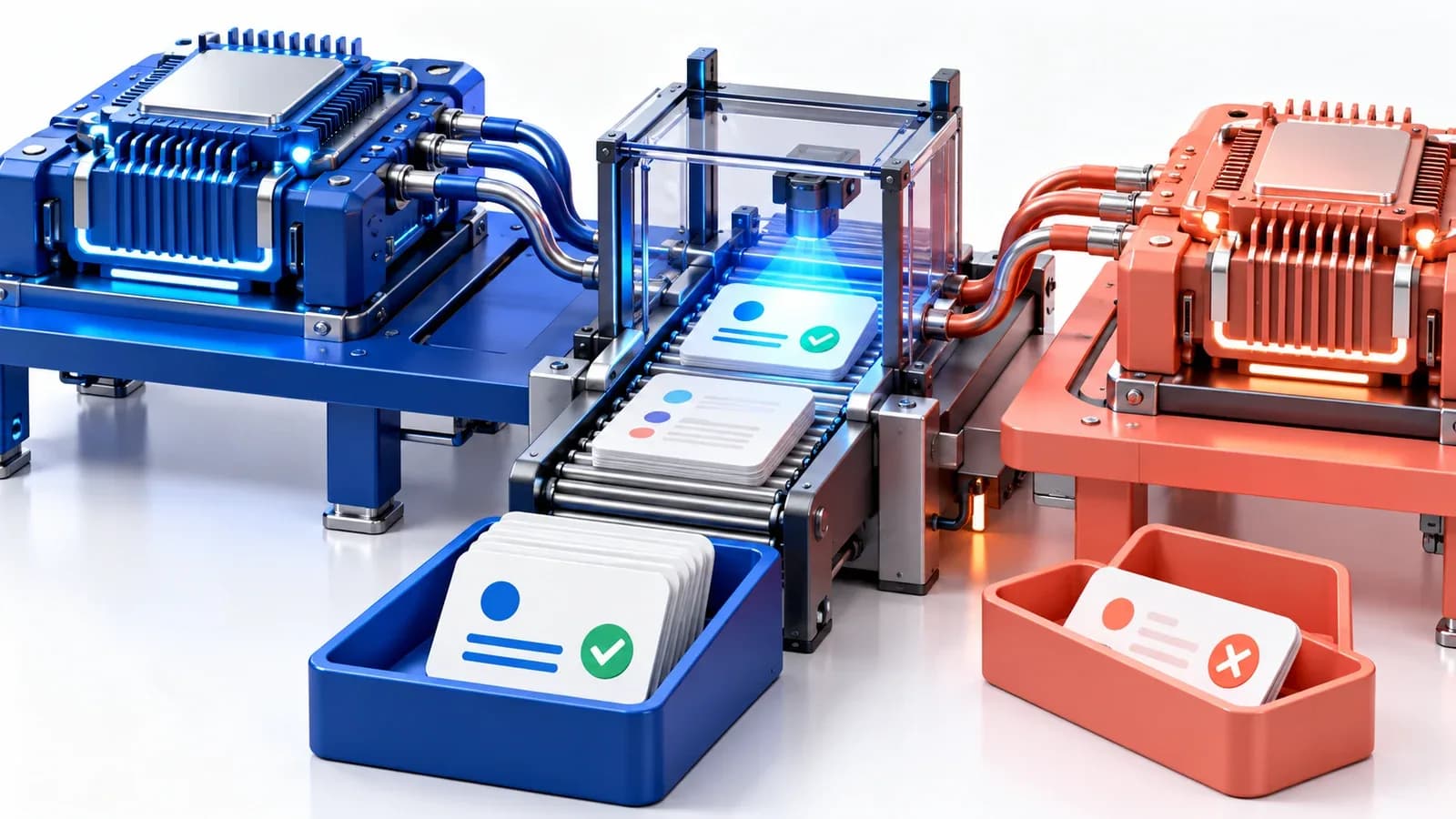
OpenAI announces GPT‑6.1 Sol on September 29, 2026, with reported improvements in programming, document processing, and workflows. For a company already using a model, the useful decision is to compare outputs and costs on its own tasks. A better benchmark score does not replace validation of the process, tools, and errors that matter in your activity.
In brief
- The announced evaluations come from the provider and defined conditions.
- The cost per task includes calls, retries, and human verification.
- A migration must be reversible and maintain action controls.
What OpenAI announces
The provider presents GPT‑6.1 Sol as an evolution of GPT‑6 Sol, especially for code, complex PDFs, and multi-step automations. The announcement publishes a standard API fee of 2 US dollars per million input tokens, $0.10 for cached inputs, and $10 for outputs.
Prices and conditions must be rechecked at the time of use. The comparisons in the press release depend on benchmarks, settings, and tools. OpenAI specifies that some evaluations are carried out in a research environment or via API, which may differ from the ChatGPT product. Daillac has not reproduced these tests.
Create a representative task set
Choose requests from your process, anonymized if necessary. Include complete documents, missing information, difficult tables, and cases requiring refusal or intervention. A set composed only of easy requests may conceal a regression.
Define the correct answer or success criteria before comparing models. For extraction, check the values and their sources. For automation, verify the final state and the operations performed. For a document, assess fidelity to sources and necessary corrections.
Compare the complete chain
TableCompare the complete chain · shareable block
| Observation to keep | Limit of a single measurement | |
|---|---|---|
| Quality | Tasks completed correctly | A convincing text can contain an error |
| Cost | Calls, tools, rework, and corrections | The token rate does not measure the entire process |
| Delay | Time until the accepted result | Generation speed sometimes excludes verification |
| Control | Refusals and authorized actions | A correct answer does not prove rights compliance |
Keep the same documents, instructions, and tools for a first comparison. If you later adjust the instructions, document this change. Otherwise, it becomes difficult to know whether the model, data preparation, or architecture explains the improvement.
The cache can change the cost when a context is reused. Its usefulness depends on the actual operation of the integration and the provider's conditions. Avoid assuming a general saving based solely on the announced price for cached entries.
Prepare a limited and reversible migration
Start with a set of tasks where the outputs can be reviewed. Keep the old version as a reference and define the return criteria: error on a critical field, tool used outside the scope, or cost exceeding the defined limit.
For sensitive operations, business rules remain separate from model judgment. A new version should not be able to approve a payment simply because it succeeds in more general tasks. Identities, rights, and confirmations remain architectural decisions.
Turn the benchmark into a local decision
The switch decision must distinguish three outcomes: observed improvement, unchanged result, and regression. For a critical field or a forbidden action, define a refusal condition before the trial. A favorable average does not justify allowing a regression that your business considers blocking.
The evaluation and model governance here serve to plan a migration: the same test cases, a record of discrepancies, limited first population, and previous version available. Daillac did not reproduce the supplier's benchmarks for this report.
A regression log for a migration
For each test case, keep the anonymized identifier, model version, instructions, available tools, expected fields, and deviations. Start with an identical configuration to isolate the model change. A second set can compare optimized instructions but must be identified separately. The focus of this report is the migration of an existing chain: a better response is not enough if the format expected by the software deteriorates.
Sources and method
OpenAI — Introducing GPT‑6.1 Sol. Sources consulted on October 1, 2026; the grids and decision examples are an editorial analysis by Daillac.
Compare the models on your real process
Provide anonymized inputs and outputs from your current integration. We can build a regression set before changing the model used.
Sources & method
Summary of the primary announcement, verified on October 1, 2026, with editorial analysis of implications, limitations, and decisions for businesses. The products mentioned have not been tested by Daillac for this article.
News feed
October 2, 2026
AI · Digital Transformation
Barclays expands Claude: lessons from an enterprise rollout for smaller businesses
October 2, 2026
Web · Performance and privacy
Vercel stops caching responses with Vary: Cookie: what to check on your site
October 2, 2026
AI · Search and integration